Demand for faster, reliable, and high-quality software products is at an all time high, forcing developers to embrace innovative strategies to stay competitive. Service virtualization technology, which enables developers to mimic the behavior of components in a distributed system, is useful in this regard as it can enhance the speed, quality, and efficiency of development and testing. This article breaks down what defines service virtualization, and how you can use it to your advantage.
What is Service Virtualization?
The TL;DR:
Service virtualization is a method used to emulate the behavior of specific components in heterogeneous component-based applications. It allows developers to operate on a self-contained environment that mirrors the production environment, facilitating parallel and isolated development, and testing activities.
In more detail:
Service virtualization is a technique that creates replicas of system components, services, and APIs, which may be currently unavailable or hard to access due to constraints such as cost, resources, or logistical hurdles. It allows software development and QA teams to work in a production-like environment by replicating these services’ behaviors, responses, and data. Service virtualization does not replicate the actual service but rather its behavior, which is sufficient for testing dependent functionalities.
Service Virtualization vs API Mocking
The terms service virtualization, API mocking, and API simulation are sometimes used interchangeably in the development world - and there is considerable overlap between them. However, understanding how these terms are typically used can help clarify the scope and scale of what you’re trying to achieve.
Here’s a two-minute summary by WireMock CTO Tom Akehurst (taken from our recent webinar):
API mocking is generally used to describe simpler, smaller-scale use cases – creating standalone mock responses for individual API endpoints or services. This might involve returning canned responses for specific requests during unit testing or local development. Mocking is typically lightweight and focused on isolated testing scenarios.
Service virtualization, on the other hand, traditionally refers to simulating entire environments under production-like conditions. This includes orchestrating multiple services together, maintaining state across interactions, simulating complex end-to-end scenarios, and creating realistic test environments that mirror how systems behave in production. Service virtualization is about system-level testing rather than component-level testing.
Rather than choosing between “mocking” and “virtualization” as distinct technologies, it’s useful to think about them as different points on a spectrum of complexity. Simple scenarios might only need basic request-response pairing, while complex scenarios require stateful behavior, orchestrated interactions, performance simulation, and error condition handling. The key is selecting a platform that can scale from simple to complex use cases as your needs evolve, rather than being locked into one end of the spectrum.
How Does Service Virtualization Work? An Example
Implementing service virtualization begins with identifying components or services that are hindering the ability to test or release software. These hindrances could be third-party services, APIs, or databases that are costly, have limited availability, or are too complex to maintain in a test environment.
Once these components are identified, a simulated service is created to emulate the behavior of the real component. This involves capturing and analyzing the interactions between the real service and the application, including request-response pairs, and replicating this behavior in the virtual service.
For example, let’s say you’re building an e-commerce application that involves multiple microservices, including user authentication, product catalog, payment gateway, and shipment tracking. These services interact with each other, and with external APIs, to provide a seamless shopping experience.
Testing this complex system in a real-world scenario can be challenging – especially when you want to validate the behavior under edge conditions like high user load, failure of a particular service, or third-party API downtime. Here, service virtualization comes into play.
Using service virtualization, you can create a virtual environment that emulates all these microservices and their interactions. You can configure the virtual services to simulate scenarios such as a sudden surge in user load, failure of the payment gateway, or the unavailability of the shipment tracking API. This enables your team to validate how the entire system behaves under these conditions, helping to uncover any potential issues and fix them before they affect the production environment.
Common Service Virtualization Use Cases
Service virtualization and API simulation solve a variety of challenges in modern software development. A few of these include:
- Parallel development: Enable frontend and backend teams to work simultaneously by prototyping APIs that don’t yet exist, eliminating waiting time and accelerating feature delivery.
- Third-party API dependencies: Simulate external services that have usage costs, rate limits, or limited sandbox availability, allowing unlimited testing without constraints.
- Unavailable dependencies: Continue development and testing when dependent services are down, under development, or not yet deployed to your environment.
- Edge case and error condition testing: Reliably simulate scenarios that are difficult or impossible to reproduce with real services, such as timeouts, network failures, specific error codes, or malformed responses.
- Load and performance testing: Test system behavior under high load without overwhelming real downstream services or incurring costs from external APIs.
- Integration environment stability: Replace unreliable shared test environments and fragile third-party sandboxes with consistent, controllable simulations.
- Cost reduction: Eliminate per-transaction fees from payment gateways, SMS providers, and other metered external services during development and testing.
- Compliance and security testing: Test scenarios involving sensitive data or regulated systems without exposing real customer information or production databases.
The Evolution of Software Development and Its Impact on Service Virtualization
The software development landscape has transformed dramatically over the past two decades, exposing significant limitations in legacy service virtualization approaches. When the first generation of service virtualization tools launched in the early 2000s, the typical enterprise released software on a quarterly basis. Development and QA were siloed teams with distinct responsibilities, testing was largely manual, and organizations managed only a handful of internal APIs using protocols like SOAP and message queues.
Today’s enterprises routinely push multiple releases per day, rely on cross-functional teams where developers own testing, and operate thousands of internal APIs using REST, gRPC, GraphQL. Automation has become essential rather than optional, and AI-powered coding tools are now standard in many development workflows. Testing is no longer the exclusive domain of QA teams but is distributed across entire engineering organizations.
This shift has created a mismatch between what legacy service virtualization tools were designed to do and what modern development teams actually need. For instance, a typical enterprise payment processing system must interact with multiple internal microservices while simultaneously connecting to external APIs for payment gateways, credit scoring services, and compliance checking systems. Development teams working on new features face blocked pipelines when any of these dependencies are unavailable.
As the number of microservices and external dependencies grows, it quickly becomes impractical to develop and test in fully integrated environments. Reliability and performance drop with every new API added, while the difficulty of configuring test data and verifying correctness increases. The result is that engineering teams struggle to ship new capabilities and time to market suffers.
Modern Service Virtualization: A Developer-Centric Approach
The shift in software development practices has required a corresponding evolution in service virtualization technology. Modern solutions must align with contemporary DevOps and CI/CD practices while enabling teams to work with greater independence and velocity. Rather than having a centralized team handle all SV creation and deployment, these platforms provide tools, templates, conventions, and guardrails that enable cross-functional teams to create and manage their own virtual services.
This shift reflects a broader change in software delivery. When organizations released software just a few times per year, irregular releases could tolerate handoffs between different teams. Contemporary requirements for multiple releases per day mandate a totally different approach, where teams must self-serve rather than waiting for specialists. Modern service virtualization platforms are characterized by several key capabilities:
- They offer low friction for occasional users or non-expert users, allowing developers to get something done without extensive prior learning.
- They emphasize automation and configuration as code, enabling teams to script operations and version control their artifacts using standard tools like Git.
- Cloud-native architecture is essential, with seamless integration into CI/CD pipelines and support for containerization.
- These platforms are designed to handle the scale of modern microservices architectures, where organizations may manage hundreds or even thousands of services, each changing multiple times per day.
- Integration with AI developer tools has become increasingly important as well. Modern platforms can leverage AI to accelerate mock creation, automatically generate API definitions, and reduce the manual effort required to set up realistic test environments.
The Ultra-Modern Solution: WireMock Cloud
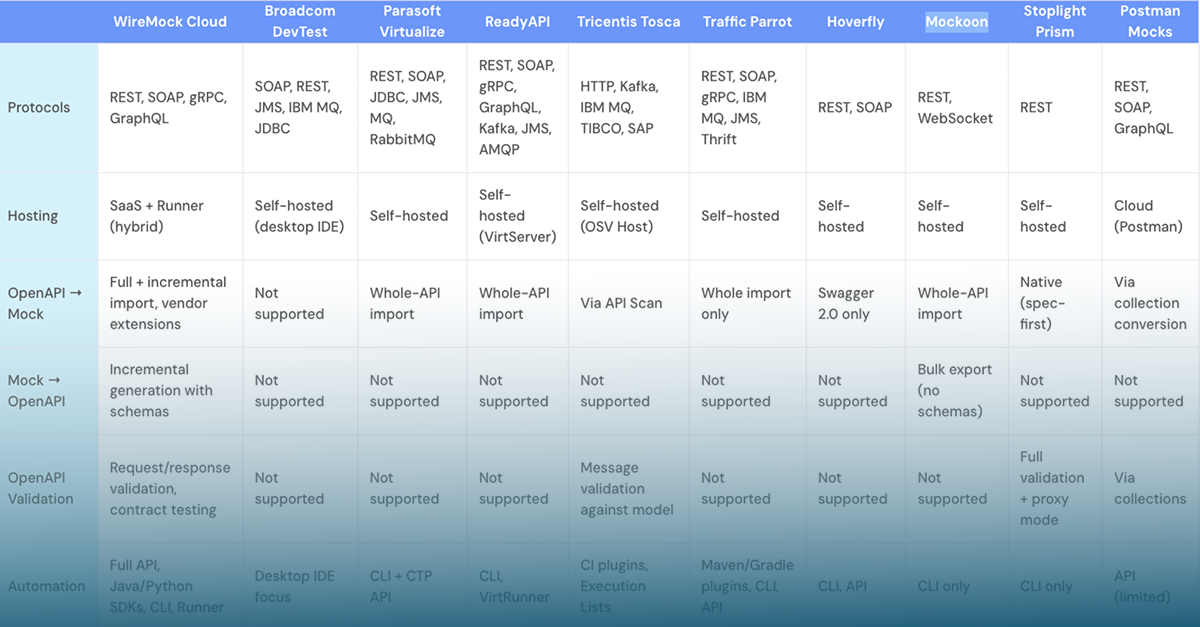
WireMock Cloud represents a modern alternative to previous-generation service virtualization tools. Built on a well-established open source foundation, it can run at any scale, from developer unit tests to large-scale multi-service load testing.
The platform enables engineering teams to build and test their microservices in fast, reliable, and isolated environments by virtualizing API dependencies. It includes advanced capabilities typically found in enterprise service virtualization solutions, (such as state management for mocked services, no-code setup options, and fault scenario simulations) but implements these capabilities in a scalable, cloud-first approach that aligns with modern DevOps and CI/CD practices.
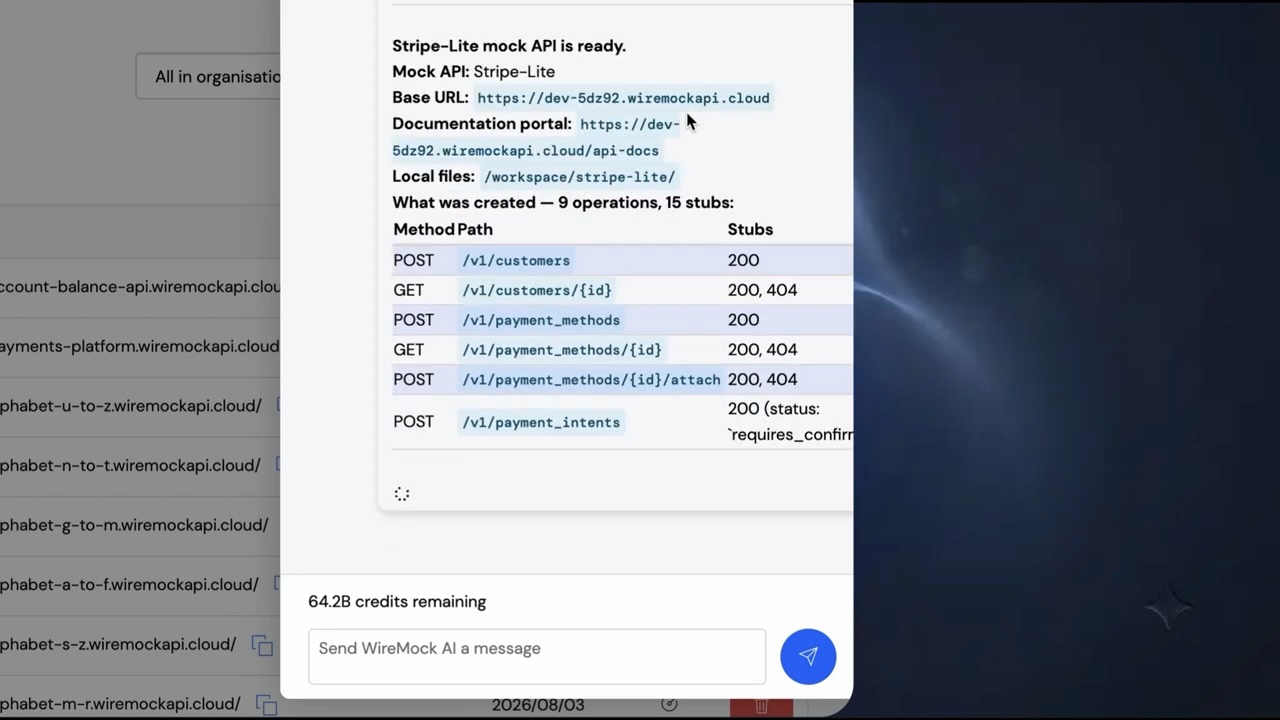
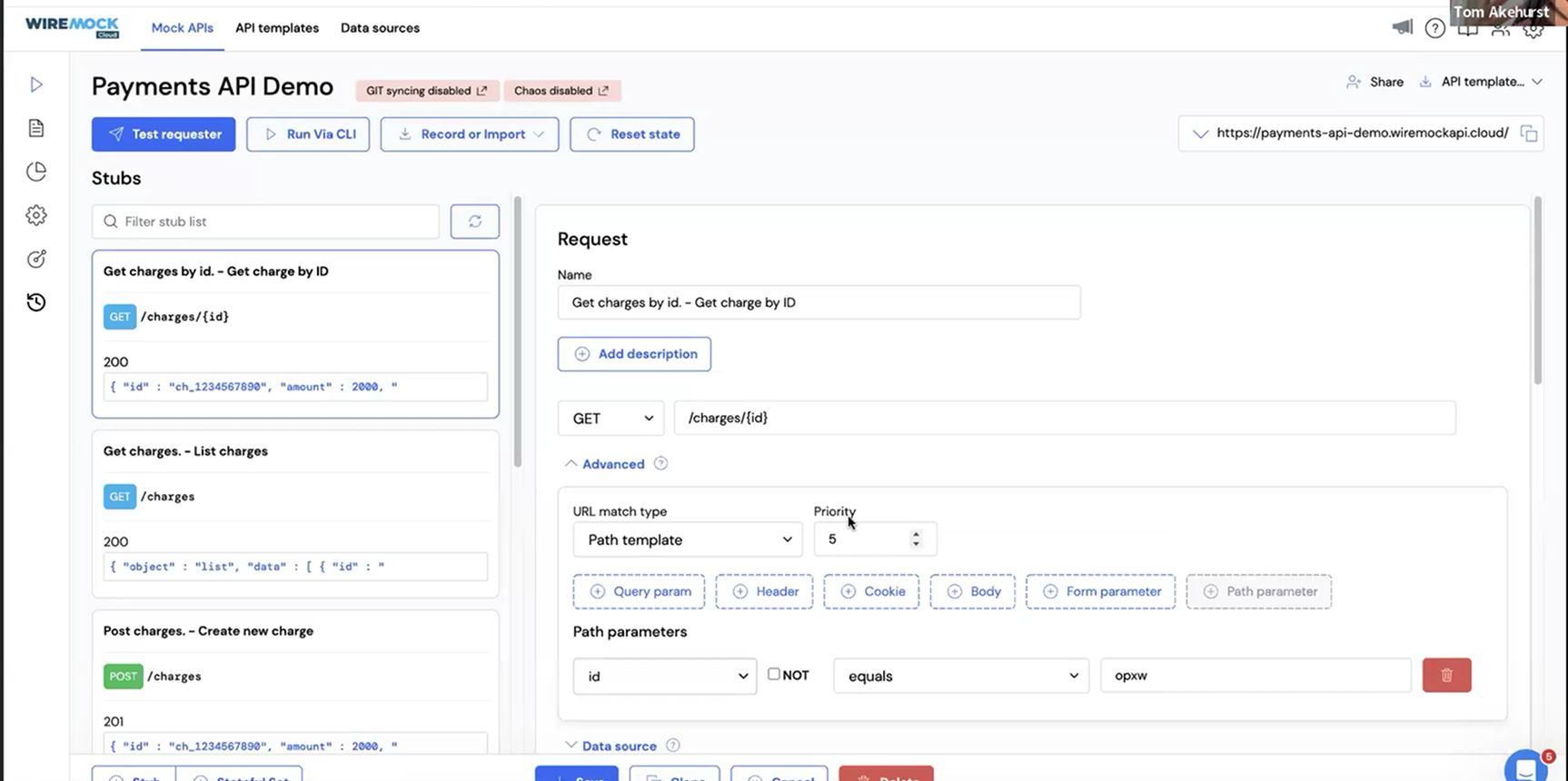
Teams can use WireMock Cloud to quickly create mocks by recording actual API traffic, importing OpenAPI specifications, generating them programmatically via WireMock’s API, integrating with AI agents through the Model Context Protocol, or manually defining responses through an intuitive interface. The platform also allows teams to capture state for use to simulate multi-step application flows like authentication followed by login, all while isolating the specific features or user flows under test.