*We talked to dozens of engineering and QA leaders about how they define and differentiate API mocking, simulation, and virtualization. Their answers reveal a gradation of shared capabilities that matters more than any single definition. *
Where Our Data Came From
As part of a recent market research project (carried out via Wynter, who collected the responses anonymously), we spoke with dozens of technical leaders across financial services, healthcare, and ecommerce about how they define and differentiate these concepts. These included VPs of Engineering and QA, Directors of Software Development, Heads of Reliability Engineering, a CISO, and a VP of IT.
What emerged was a gradation of shared capabilities that reveals how experienced leaders think about the space.
Why it matters: For us, this was foremost about finding the best way to describe our product. However, we think the results are more broadly relevant for anyone looking to understand the current testing landscape. While this was a small sample, we came into it without any type of bias as we were looking to understand how the market thinks, rather than create a marketing-oriented research assets.
Ask your frontend team how they handle unavailable APIs and they’ll say they “mock them.” Ask your QA director and they’ll say “service virtualization.” Ask an engineer building self-serve environments and they’ll land on “simulation.” While they may actually be describing the same tool, differing terminology often leads to three distinct budget items.
Each term carries different assumptions about the problem being solved, the sophistication required, and who the tool is for. And this confusion is becoming increasingly expensive as handfuls of integration points are turned into dozens or hundreds, and AI agents multiply features, which still have to be validated against the same overbooked dependencies.
How Technical Leaders See Mocking, Simulation, Virtualization, and Emulation
Let’s look at some of the responses we got. While definitions varied, respondents consistently placed these four terms along a range from simple to sophisticated: mocking, emulation, simulation, and virtualization.
| Mocking | Emulation | Simulation | Virtualization | |
|---|---|---|---|---|
| What it implies | Static, predefined responses | Varies widely | Realistic behavior + business logic | Full environment replication |
| Typical use | Unit tests, early dev | No consensus | Integration testing, scenario testing | Performance testing, environment isolation |
| Response type | Static | Static to dynamic | Dynamic, scenario-based | Dynamic, stateful |
| Perceived complexity | Simplest | Contested | Mid to high | Highest |
| Who uses the term | Developers | Varies | QA + Platform teams | Enterprise SV teams |
Mocking and Virtualization: The Bookends
The vast majority of those we spoke to picked mocking as the easiest term to understand. Definitions were consistent: static responses, predefined data, early-stage development. A Lead Architect in healthcare described it as “a manual JSON representation of what the API can return”, while a Development Integration Manager at a financial services firm called it a “Simplified version for testing specific functions.”
Virtualization sits at the other end, with roughly half ranking it as the most complex term and associating it with full environment replication. A Senior SQA Engineering Manager in healthcare described it as simulating “full API behavior and data flows” for “integration and performance testing in isolated environments”, while a VP of Software QA in financial services framed it as “dynamic, scalable replicas of API environments.” But the term carries baggage: some respondents defined it in infrastructure terms – “when you aren’t putting things on prem hardware” – rather than API behavior.
Emulation: The Term Nobody Could Pin Down
If mocking and virtualization are bookends, emulation fell behind the shelf. One participant picked it as the easiest to understand, and one placed it as hardest. For many, it’s a step above mocking – “a more elaborate emulated version of the original API,” as a Head of Reliability Engineering in financial services put it. Others treated it as interchangeable with simulation. Essentially, if you use “emulation” in a planning meeting, expect follow-up questions.
Simulation: Where Behavior Enters the Picture
Simulation is where things shift from “what does the API return” to “how does the API behave.” A Software Engineering Manager at an ecommerce company described it as “simulating close to real API behavior with business functionality.” A VP Tech Lead in fintech: “replicating real-world API interactions and scenarios to test how applications behave under various conditions.” Rankings varied, but averaged out as the third most complex term. However, definitions pointed in the same direction: dynamic, behavior-oriented, beyond static request-response.
The Shared Problem Beneath the Vocabulary
What this spectrum really describes is a single underlying need: teams want to simulate the environments their code depends on - realistically and on demand. Whether someone calls that “mocking” or “virtualization” says more about their org chart than about the capability itself. The labels shift; the requirement doesn’t.
That showed up clearly when we started asking about value. While definitions varied, what these leaders actually want barely varied at all:
-
Simulating dependency-heavy environments: When we described the capability to “remove the impact of API dependencies in your software delivery lifecycle,” 80% rated it as “Very Valuable”. The remaining three said “Somewhat Valuable”. There were zero dismissals.
-
Self-service against a single source of mocked API: A Head of Reliability Engineering at a financial services firm described the cost when that independence is missing: “We end up having to mock up a lot of the APIs and then eventually when moving into UAT; we find many differences in the behaviors of the mocked-up APIs versus the actual external APIs – and this costs us testing time.”
-
Increasing the reliability of testing: This is particularly important in regulated industries such as financial services or healthcare, where the stakes are higher and real data is often difficult to access. A Senior QA Manager at a healthcare company explained that simulated APIs “may not have access to real, live data or the complete set of data rules.” In a HIPAA-regulated environment, a simulation that misses edge cases can pass testing and fail in production where patient safety is on the line.
Across our conversations, the same desired capabilities surfaced: dynamic responses, stateful behavior, CI/CD integration, support for error scenarios, and spec-based generation. While the vocabulary may differ, the wish list doesn’t.
Why WireMock Landed on “Simulation”
WireMock started as a mocking library, and mocking is still a core capability. But the term undersells what modern teams actually need from these tools.
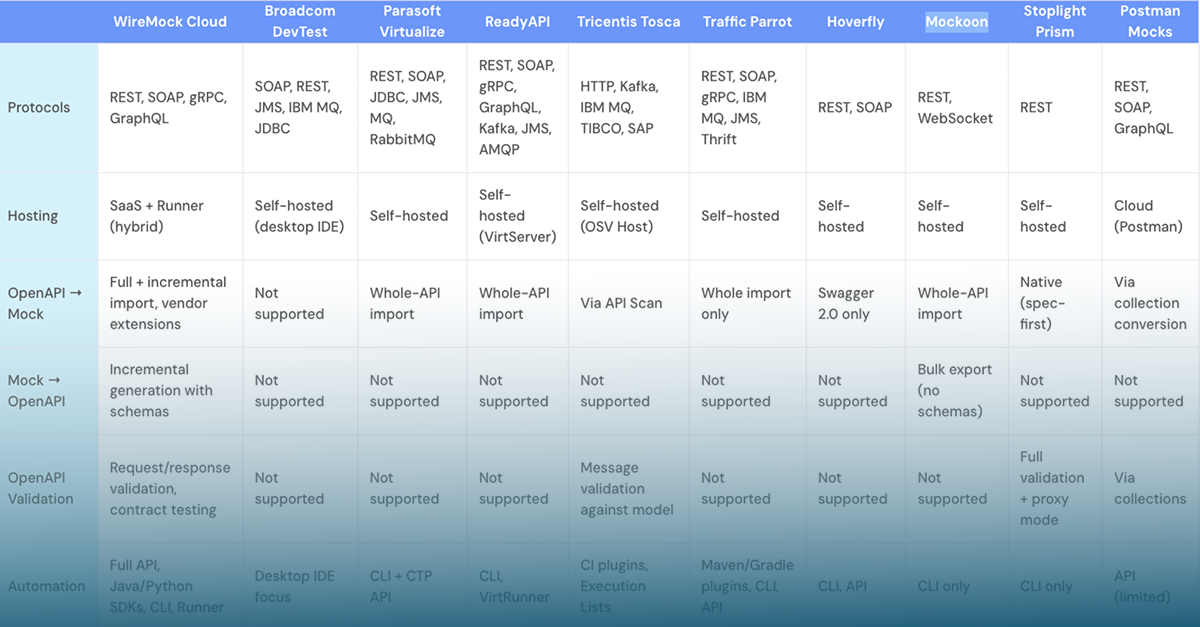
When figuring out how to describe what WireMock Cloud does — stateful multi-step flows, fault injection, traffic replay across REST, gRPC, and GraphQL — “virtualization” was the obvious candidate. The capabilities are there: WireMock Cloud does everything the established service virtualization tools do, plus native AI integration, Git-based configuration, and pricing that aligns with the actual value of the product (rather than ever-increasing renewal and maintenance fees)..
However, the term itself has some unwanted connotations. Teams hear “service virtualization” and picture desktop IDEs, proprietary formats, centralized COE teams, and procurement cycles that outlast the projects they were meant to support. We didn’t want the label; we wanted to move past the model it represents. What WireMock Cloud actually delivers is environment simulation - the ability to replicate how your API dependencies behave in production, including failures and state transitions, accessible to every developer and every CI pipeline without a specialized team in the middle.
The bottom line is that while your team calls it mocking, and your VP calls it virtualization, neither is wrong. They’re pointing at different spots on a continuum the industry is still mapping. But the capabilities they both need have already converged. Pick the term that fits your org chart. Then pick the tool that fits your architecture.