
If you’ve built your testing infrastructure around Mountebank, the past year has probably given you pause. The original maintainer stepped away in May 2024 after more than a decade of development, citing the immense demands of “nights, weekends, and holidays” spent maintaining the tool – which has now entered a transition period that raises serious questions for dependent teams.
This isn’t a cause for panic (yet). Mountebank has a community fork maintaining basic updates, and version 2.9.2 shipped in September 2025 under new community management. But with pull request merging paused and npm analysis flagging the project as potentially discontinued, many engineering teams are quietly evaluating their options.
This guide covers seven alternatives to Mountebank for API mocking and service virtualization. We’ll look at what each tool does well, where it falls short, and for which scenarios each is best suited.
Information about non-WireMock products below is based on what we gathered online. If there are any inaccuracies, please contact us*** and we will correct them.***
1. WireMock Cloud: Enterprise API Simulation and Service Virtualization
What is it
WireMock Cloud is an enterprise-grade API simulation platform that evolved from WireMock OSS – the API mocking library that’s been a mainstay of Java testing since 2011. It goes beyond simple mocking to provide full service virtualization capabilities, enabling teams to create realistic test environments without depending on live services.
Where most mocking tools limit you to HTTP, WireMock Cloud provides native support for REST, GraphQL, and gRPC out of the box – alongside stateful mocking, chaos engineering, role-based access control, SSO via OpenID Connect, and Git integration for version-controlling mock configurations.
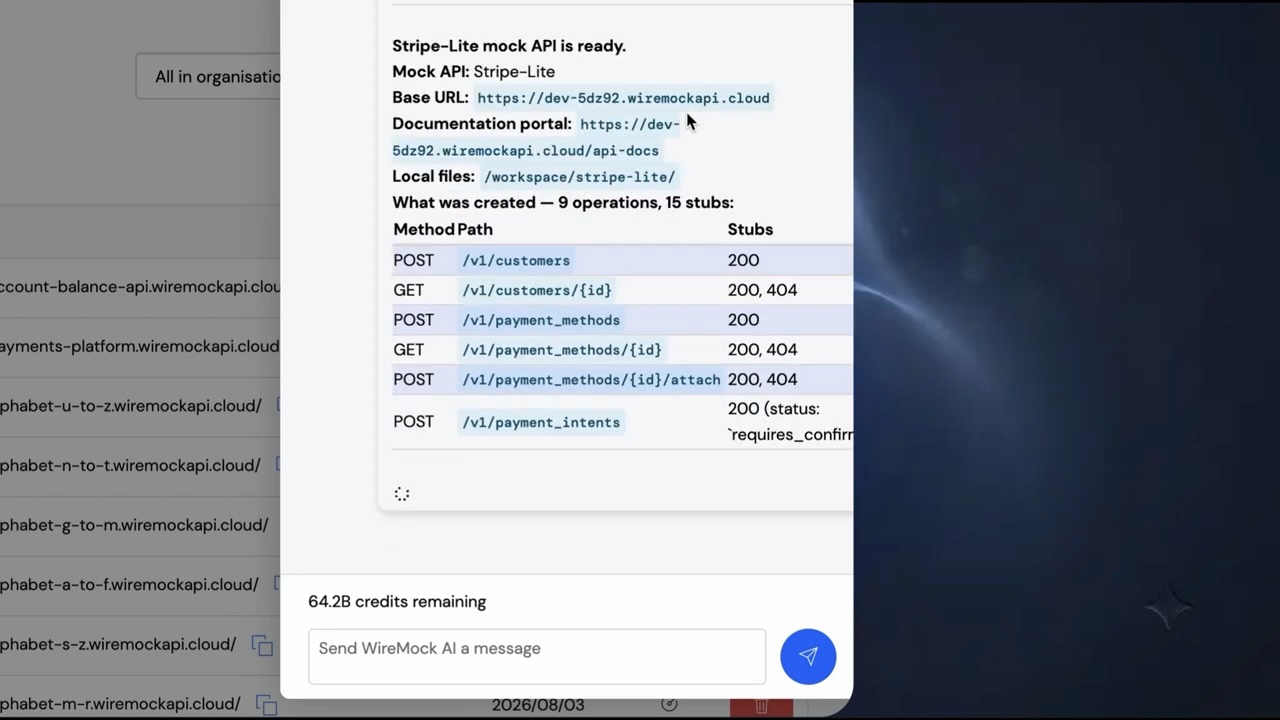
WireMock Cloud also includes a native MCP (Model Context Protocol) server that connects with AI coding assistants like Cursor or GitHub Copilot, enabling AI tools to generate production-realistic API simulations directly from your development environment.
Why it’s a good alternative
WireMock Cloud can replace full legacy service virtualization implementations while providing the flexibility to run anywhere. The WireMock Runner enables hybrid deployments across Kubernetes, Docker, or on-premises environments – meaning you’re not locked into a single deployment model.
Advanced capabilities include network-level fault simulation, probabilistic failure policies, and comprehensive debugging with non-match diffs and validation reports. For teams migrating from Mountebank, the extensive protocol support, OSS foundation, and mature ecosystem provide a stable foundation.
Who should use it
Teams that need enterprise features (RBAC, SSO, SOC 2 compliance), multi-protocol support (GraphQL, gRPC), advanced functionality (stateful mocking, AI-native integrations), or managed infrastructure. It’s also the natural choice for organizations already using WireMock OSS who want a supported upgrade path, and for teams looking to replace legacy service virtualization tools with a more modern, flexible platform.
2. WireMock OSS: Developer-Focused API Mocking Library
What is it
WireMock OSS is the open-source foundation on which WireMock Cloud builds. The numbers speak to its position in the ecosystem: over 6 million monthly downloads, 7.1k GitHub stars, 259 contributors, and more than 4,300 commits. Version 3.13.2 shipped in November 2025, demonstrating active ongoing development, and the project maintains an active Slack community with a dedicated #help channel for support.
WireMock OSS covers the essentials that most teams need:
- HTTP response stubbing with pattern matching on URLs, headers, and body content
- Multiple configuration approaches: fluent APIs, JSON files, or HTTP-based REST interfaces
- Request verification for asserting that expected calls were made
- Support for multiple languages and testing frameworks
- Fault injection and response delay simulation
- Conditional proxying
- Dynamic templated responses
- Extensions for gRPC, GraphQL, and JSON web tokens
Why it’s a good alternative
WireMock OSS offers the most comprehensive open-source API mocking capabilities available. Its code-first approach means all building blocks are accessible via APIs and have a well-defined external JSON form that’s portable and Git-friendly. The extensive community support and active development ensure long-term viability.
Who should use it
Individual developers comfortable with self-management, and organizations that prefer to maintain their own infrastructure and have simpler requirements. WireMock OSS is a developer tool, not a team platform – it doesn’t include a web UI, built-in team collaboration features, or enterprise security options like SSO. For capabilities like advanced stateful scenarios and chaos engineering modes, check out WireMock Cloud.
Explore WireMock OSS on GitHub
3. Mockoon: Desktop-First GUI for API Mocking
What is it
Mockoon is an open-source API mocking tool that takes a desktop-first approach, providing an Electron-based GUI application for developers who prefer visual interfaces over configuration files. It also offers a CLI and Docker support for headless deployment, and has recently launched a cloud (SaaS) edition.
Mockoon is a one-person company, not VC backed, and relies on community donations and contributions for development.
Why it’s a good alternative
Mockoon provides an intuitive visual experience with unlimited mock servers and routes. Its modern UI design makes it accessible for developers new to API mocking, and the CLI tool enables basic CI/CD integration. OpenAPI import is supported, though bulk operations only without JSON schema generation.
Who should use it
Individual developers who prefer GUI tools over code-based configuration and don’t need team collaboration or advanced simulation features. Be aware of its limitations: Mockoon lacks a full API so cannot be scripted in unit tests the way WireMock can. OpenAPI capabilities are basic (no schemas) and bulk-only. There’s no traffic validation support, and the self-hosted nature presents collaboration barriers. It supports HTTP-level error codes and fixed delays only – no network-level faults or chaos engineering modes. Enterprise features like SSO, RBAC, and OIDC security are not available.
4. Hoverfly: Capture-Replay API Simulation
What is it
Hoverfly is a Go-based API mocking and service virtualization tool with both open-source and cloud editions. It emphasizes capture-replay workflows – rather than defining mocks upfront, you can record real API traffic and play it back in testing. The tool offers flexible matching and templating systems, a lightweight footprint, cross-platform support, and Kubernetes sidecar mode.
The Hoverfly Cloud product uses a portable data format that can be moved between the OSS and Cloud versions.
Why it’s a good alternative
Hoverfly is well-suited for teams whose workflow centers on capturing and replaying real traffic rather than designing mocks from specifications. It supports CSV data sources and stateful mocking, and provides HTTP-level fault simulation with basic randomization.
Who should use it
Teams doing capture-replay testing with primarily REST APIs. Keep in mind that Hoverfly does not support gRPC, GraphQL, or async/messaging protocols. External format interoperability is limited to Swagger 2.0 import only – no OpenAPI output or validation. It lacks enterprise features including SSO, RBAC, and OIDC/OAuth security on mock APIs. Network-level fault simulation is not available.
5. Stoplight Prism: Simple Prototyping Based on API Docs
What is it
Prism is an open-source mock server from Stoplight that generates mocks from OpenAPI specifications. If you have comprehensive OpenAPI docs, Prism can generate dynamic responses automatically using Faker.js, with support for OpenAPI v2, v3.0, and v3.1.
Prism’s OpenAPI-first approach is both its primary strength and its main limitation – everything flows from the specification.
Why it’s a good alternative
For teams with mature, well-defined OpenAPI specifications, Prism offers an efficient way to generate specification-compliant mocks automatically. Request validation against specs ensures responses align with your API documentation.
Who should use it
Stoplight is best suited for bringing API docs to life, but request and response configuration is too limited (due to the inherent constraints of OpenAPI): request matching is limited to what’s defined in the OpenAPI document, making it difficult to test edge cases or undocumented behaviors. It’s stateless by design, so unsuitable for testing workflows that depend on previous interactions. There’s no external data source support or database integration, and only basic request logging without comprehensive debugging tools.
Prism is CLI-only with no graphical interface, requiring custom scripting for CI/CD integration. Its single-process architecture limits concurrent request handling, and there’s no built-in performance monitoring or load testing capabilities. Fault injection, latency control, and chaos engineering are not supported. If your specifications are incomplete, or you need capabilities beyond what OpenAPI can express, Prism might fall short.
6. Postman Mock Server: Collection-Driven Mocking for API Design
What is it
Postman Mock Server integrates API mocking into the broader Postman platform. It’s primarily designed for collaborative API design and documentation, using a collection-driven approach where mocks are generated from Postman collections. Postman has also added gRPC mocking support from Protobuf definitions.
Why it’s a good alternative
If your team already lives in Postman, Mock Server offers a familiar setup experience and integrates with Postman’s design and documentation features. It supports dynamic response generation and configurable response delays.
Who should use it
Postman mocking would usually be used for doc/demo/design support purposes, and falls short otherwise. Small teams already committed to the Postman ecosystem who can work within its constraints. Those constraints include limited request matching (primarily method + URL + query parameters), no native stateful mocking (teams approximate this with Flows), and no external data sources for mocks.
Performance testing is impractical due to rate limits of 120 calls per minute. Network-level fault simulation is not available – only basic delays and HTTP error codes. While Postman supports RBAC and Audit Logs at the Team level, there’s no per-mock endpoint authentication (OIDC/HTTP Basic). Automation has improved via CLI, but many workflows depend on Postman’s cloud, creating an external dependency. The tight ecosystem integration may create vendor lock-in concerns.
7. JSON Server: Quick REST API Prototyping
What is it
JSON Server creates a fake REST API from a JSON file with zero coding. Point it at a JSON file and you instantly get a RESTful API with CRUD operations.
Why it’s a good alternative
JSON Server is unmatched for speed when you need a throwaway API in minutes. Simple setup, no configuration required, and it works out of the box.
Who should use it
Quick demos and throwaway prototypes where you need a fake API immediately and don’t care about realistic behavior. This is a prototyping tool, not a testing tool. It lacks authentication, fault injection, multi-protocol support, and data persistence across restarts. Not suitable for any serious testing scenario.
Comparison Table
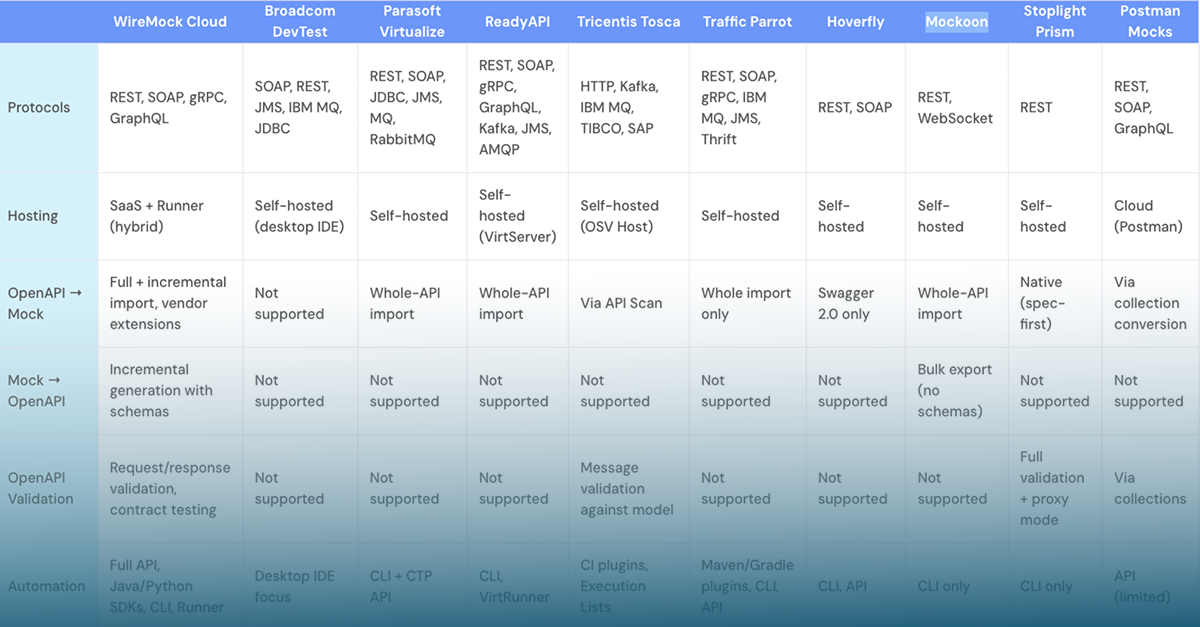
| Feature | WireMock Cloud | WireMock OSS | Mockoon | Hoverfly | Prism | Postman Mock | JSON Server |
|---|---|---|---|---|---|---|---|
| Maintenance Status | Active (Enterprise support) | Active | Active | Active | Active | Active | Active |
| Protocol Support | REST, GraphQL, gRPC, SOAP | REST (extensions for others) | HTTP/HTTPS | HTTP, WebSocket | HTTP | HTTP/HTTPS | HTTP |
| Team Collaboration | RBAC, SSO | No | No (paid Cloud) | No | No (Stoplight) | Partial (paid) | No |
| Enterprise Security | SOC 2, OpenID Connect | No | No | No | No | Partial | No |
| Stateful Mocking | Yes | Limited | No | No | No | No | No |
| Chaos Engineering | Multiple modes | No | No | No | No | No | No |
| UI Available | Web UI + CLI | CLI/code only | Desktop GUI | Limited | CLI only | Postman app | CLI only |
| OpenAPI Support | Full bidirectional | Via extensions | Yes | No | Required | Via Postman | No |
| CI/CD Integration | Strong | Strong | CLI available | Good | Good | Limited | Minimal |
| Community Size | Enterprise backed | 7.1k stars | 8k stars | 2.5k stars | 4.8k stars | N/A | N/A |
| Pricing | Usage-based | Free | Free/paid Cloud | Free/paid Cloud | Free/paid | Free/paid | Free |
Going Beyond Simple Mocking
Mountebank served the API mocking community well for over a decade. Its transition to community maintenanceisn’t lights out, but it does mean that teams with large production dependencies would be wise to reevaluate their options (and fast).
For enterprise teams that need collaboration features, security certifications, and advanced capabilities like stateful mocking or chaos engineering, WireMock Cloud offers a complete platform backed by professional support. Customer case studies show setup times measured in minutes rather than days, with usage-based pricing that scales with your needs.
For smaller teams that are comfortable managing their own infrastructure and have simpler requirements, WireMock OSS provides a mature, actively-maintained foundation with the largest community in the space. And if your needs evolve, the upgrade path to WireMock Cloud is just a few clicks away.
Talk to a WireMock expert about migrating from Mountebank
Want to continue exploring solutions? See our comparison of top service virtualization tools