Service virtualization lets you simulate the APIs and services your application depends on, so you can test and develop without waiting for external dependencies to be available, stable, or complete. This guide covers the major tools in the space and helps you pick the right one for your situation.
What is service virtualization? It’s the practice of simulating the behavior of the APIs, services, and systems your application depends on, so you can develop and test without needing every real dependency available at once. New to the concept? Start with our service virtualization glossary entry — this guide focuses on choosing a tool.
How We Evaluated Solutions
- This review is based on the WireMock team’s experience in the service virtualization market over the last decade (with WireMock OSS, Mocklab, and WireMock Cloud).
- Our team has encountered many of these tools at customer environments or in discussions with partners*. *The author interviewed the WireMock team and distilled their findings into this article.
- Additional information about non-WireMock products is to the best of our knowledge and based on publicly available information.
- If we got anything wrong, please feel free to get in touch.
Understanding Today’s Service Virtualization Market
Service virtualization has been around for almost twenty years, and the problem it solves has changed dramatically over time. When enterprise SV tools first emerged, organizations managed tens of services - almost all on-premise monoliths. Today, companies routinely operate thousands of microservices in complex cloud and hybrid environments, all releasing multiple times daily. Add AI-assisted development accelerating code production, and the bottleneck has shifted to testing against all those integration points.However, not all tools have evolved to match modern workflows.
Types of Tools and When to Choose Each
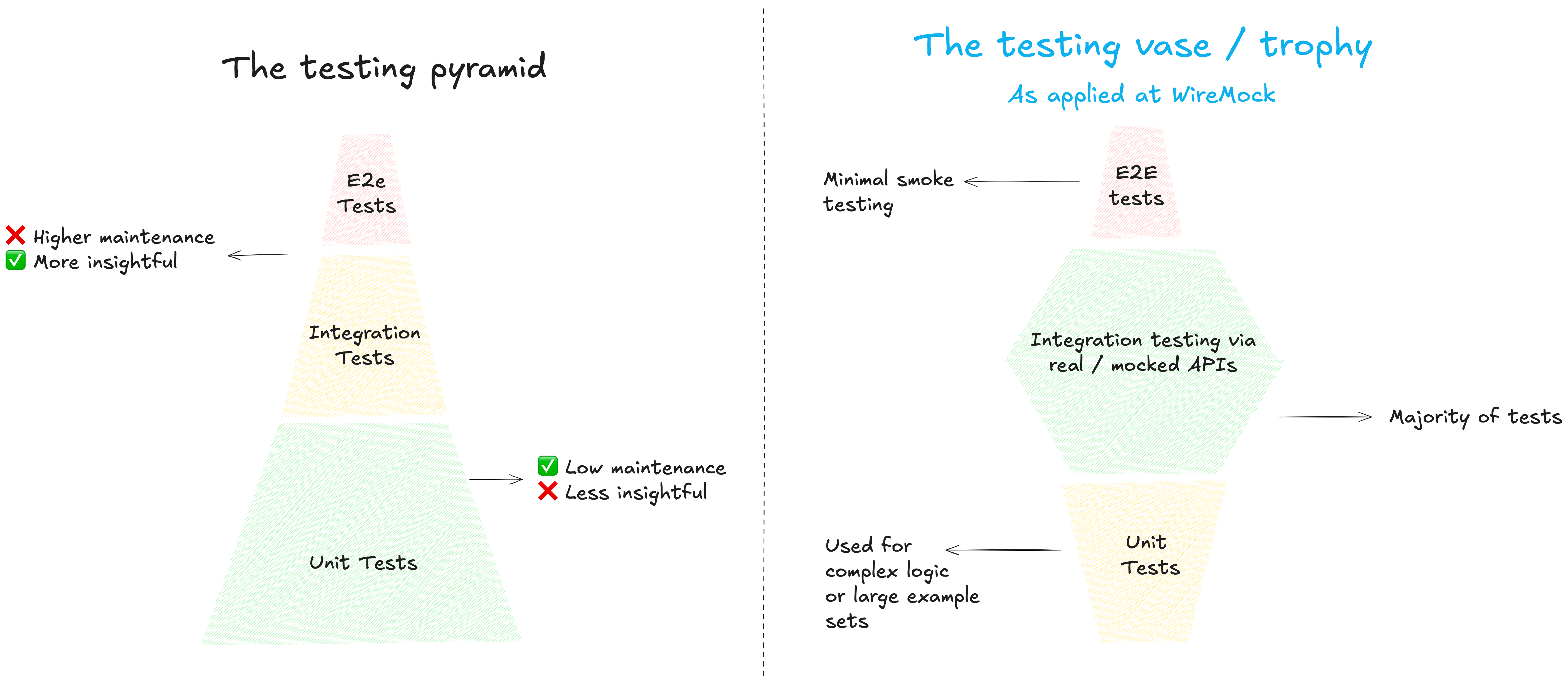
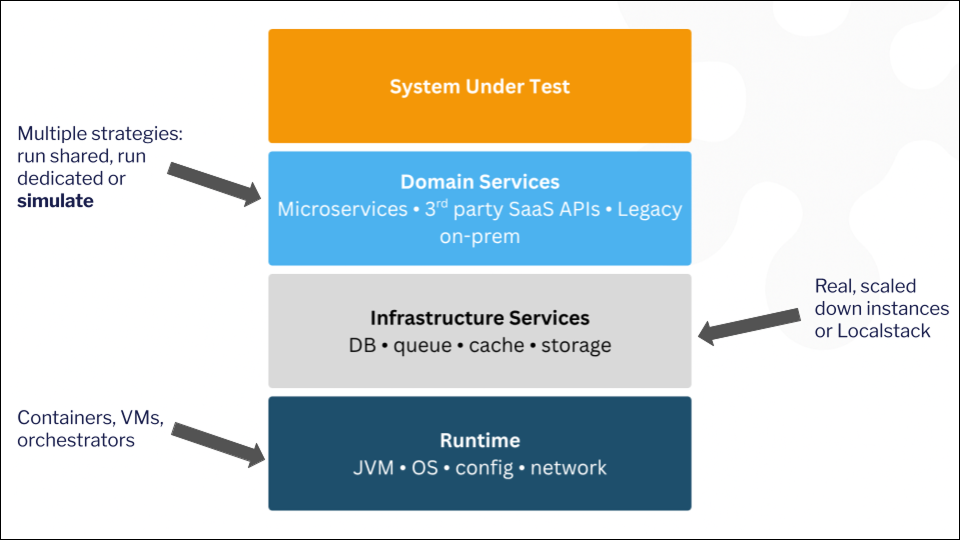
Service virtualization tools exist on a spectrum from lightweight mocking libraries to full enterprise platforms. The difference between mocking and virtualization can get murky, but we typically refer to mocking as a more lightweight and localized simulation of a specific API rather than simulating full environments. Within this overall landscape, you might find:
- Mocking libraries and frameworks give developers direct control. You define stubs in code or configuration files, run them locally or in CI, and version them alongside your application. They’re free, flexible, and fit naturally into developer workflows. The tradeoff: you’re responsible for hosting, scaling, and managing complexity as your mocking needs grow. What’s more, if you are looking beyond “runs on my laptop” use cases, you might have an uphill battle ahead - as these tools were not really designed for centralized, collaborative work.
- Standalone mock servers add protocol support and recording capabilities without requiring code changes. They work well for teams that need to simulate services without modifying test code, or that need to capture and replay real traffic. Most are open source with active communities.
- Legacy service virtualization tools are typically offered as part of larger test automation suites and are designed to emulate complex legacy systems and centralized testing teams. They will come at significant cost (often six-figure renewals), longer setup times, and workflows that may not match how modern development teams work.
- Modern simulation platforms offer cloud-native deployment, CI/CD integrations, flexible mocking capabilities, and native support for agentic AI development (such as via MCP or Skills). In this paradigm, developers create and manage mock services through APIs and UIs without infrastructure overhead; and the virtualization tool is built around current ways of working - short release cycles, shifted-left testing, and faster delivery through AI-assisted coding.
Today, developers might use lightweight libraries or standalone tools for ‘toy’ use cases on their local machine. At enterprise scale, we are seeing a shift from legacy service virtualization to modern platforms such as WireMock Cloud - a shift we’ve covered in our previous article on the service virtualization market.
Evaluation Criteria: What to Look For in a Service Virtualization Tool
Architecture. Cloud-native tools integrate naturally with remote teams, CI pipelines, and containerized environments. Desktop-centric tools require workarounds for modern workflows.
AI readiness. Teams using AI coding assistants need tooling that integrates with those workflows, including emerging standards like MCP (Model Context Protocol). This is increasingly a differentiator.
Centralized vs. decentralized approach: The previous generation of tools assumed a centralized SV team is responsible for creating and maintaining simulations. Consider whether this aligns with how you develop software today.
Automation and CI/CD support. Can you manage configurations as code? Does the tool have APIs for pipeline integration? Tools built for continuous deployment look very different from those designed for quarterly releases.
Protocol support. REST is table stakes. Many teams also need SOAP for legacy systems, gRPC for internal services, GraphQL, or async protocols like Kafka. Know what you need before you evaluate.
Team workflow. Can developers create mock services themselves, or does every request go through a centralized team? Does the tool support Git workflows for versioning and review? Self-service capabilities matter more as teams scale.
Pricing model. Traditional enterprise contracts will often include significant support or implementation fees.
With these criteria in mind, here’s how the major players compare.
At a glance
| WireMock Cloud | Broadcom DevTest | Parasoft Virtualize | ReadyAPI | Tricentis Tosca | Traffic Parrot | Hoverfly | Mockoon | Stoplight Prism | Postman Mocks | |
|---|---|---|---|---|---|---|---|---|---|---|
| Architecture | Cloud-native SaaS + hybrid Runner | Desktop IDE, on-premise | Desktop IDE, self-hosted | Hybrid (cloud UI, self-hosted VirtServer) | Self-hosted OSV environment | Self-hosted server | Self-hosted | Desktop app / self-hosted | Self-hosted CLI | Cloud-hosted |
| AI Readiness | AI-native design with MCP server and continuous optimization for agentic AI | None | Natural language assistant | HaloAI (limited) | Tosca Copilot (UI only) | None | None | None | Via SmartBear HaloAI | Postbot chatbot |
| Approach | Decentralized / self-service | Centralized admin team | Centralized specialists | Centralized / hybrid | Centralized (OSV team) | Developer self-service | Developer self-service | Developer self-service | Developer self-service | Team-based |
| CI/CD Support | Full API, CLI, Runner, Git integration | Limited (desktop focus) | CLI + CTP API | CLI, VirtRunner | CI plugins, Execution Lists | Maven/Gradle, CLI | CLI, Docker | CLI | CLI, Docker | Newman CLI (limited) |
| Protocol Support | REST, SOAP, gRPC, GraphQL, async (Q2 2026) | SOAP, REST, JMS, IBM MQ, JDBC | REST, SOAP, JMS, MQ, RabbitMQ | REST, SOAP, gRPC, Kafka, JMS | HTTP, Kafka, IBM MQ, TIBCO | REST, SOAP, gRPC, JMS, MQ, Thrift | REST, SOAP | REST, WebSocket | REST | REST, SOAP, GraphQL |
| Team Workflow | Self-service, Git workflows, RBAC | Requires admin team | Specialist-driven | Mixed (UI + scripting) | Model-based, codeless | Git-based definitions | Config as code | Local-first | Spec-first | Collection-based |
| Pricing Model | Usage-based tiers | 7-figure enterprise contracts | Enterprise license | Tiered license | Enterprise license | Per-server license | Free OSS / paid cloud | Free OSS / paid cloud | Free OSS | Free tier / team plans |
Enterprise-Grade Service Virtualization Tools
The enterprise service virtualization market includes established platforms designed for large-scale, multi-protocol environments as well as modern alternatives built for cloud-native workflows. Here are the major players worth evaluating.
WireMock Cloud — AI-Native API Simulation
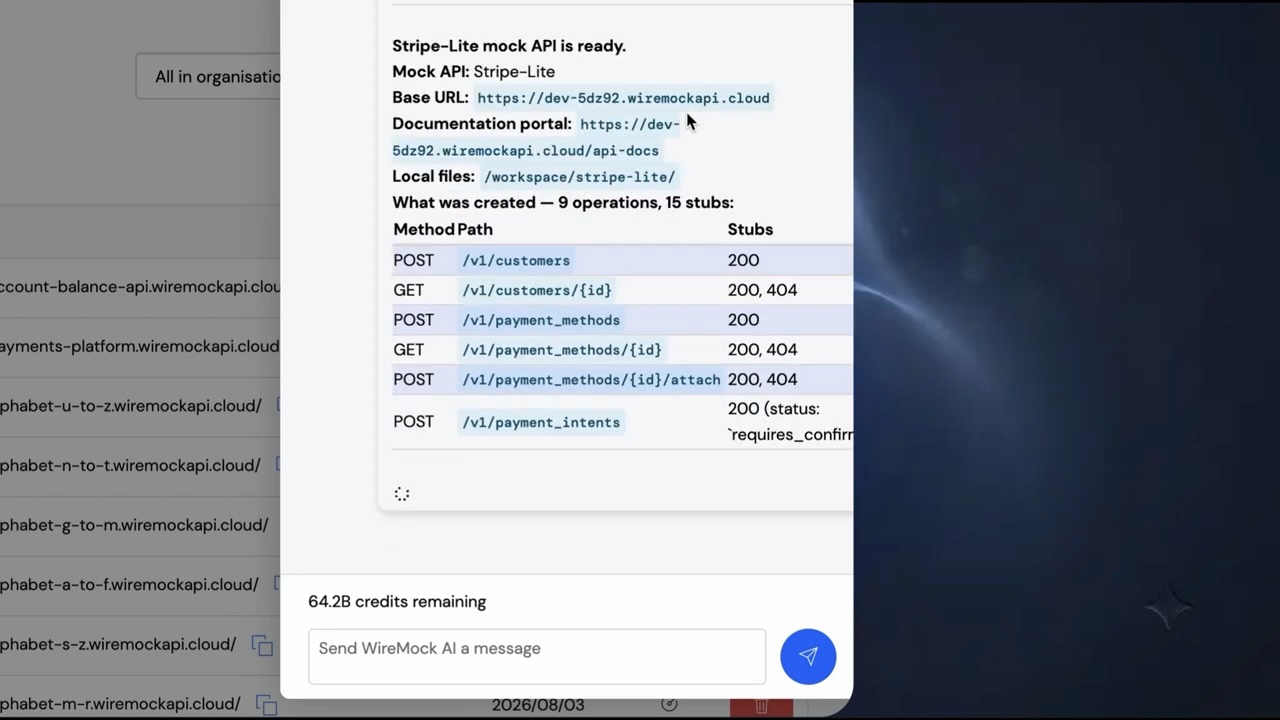
WireMock Cloud combines enterprise-grade capabilities with modern development workflows. The platform is designed to provide stable environments where developers, testers, and AI coding agents can write and test code against simulated API dependencies which maintain a high level or realism thanks to features such as stateful mocking and data sources. WireMock Runner extends WireMock Cloud to anywhere your code runs - such as in your Kubernetes Cluster or your CI/CD pipeline.
Strengths:
- Cloud-native design with sleek modern interface
- Comprehensive platform with advanced functionality and features including stateful mocking, full environment simulation, chaos testing, and more
- Native MCP server integration enables AI coding agents like Cursor and Claude Code to generate production-realistic simulations with full codebase context
- Self-service model lets development teams create their own simulations instead of waiting on centralized admin teams
- Bidirectional OpenAPI support: generate mocks from specs and specs from mocks
- Hybrid workflow capability with WireMock Runner allows local execution and CI/CD integration while syncing with the cloud
- Git integration supports configuration-as-code workflows
- SOC 2 certification and RBAC address enterprise compliance requirements
Real-world results:Ally Financial shifted from a centralized bottleneck model to self-service capability across 20+ external APIs. Their previous tool required years of accumulated virtualized services that demanded an admin team to manage. With WireMock Cloud, development teams create their own simulations as needed.
Broadcom DevTest (formerly CA LISA / ITKO LISA): The Legacy Leader
DevTest has changed hands twice, which is why teams still search for it under three names. ITKO built the original LISA platform; CA Technologies acquired ITKO in 2011 and sold it as CA Service Virtualization (many practitioners kept calling it CA LISA); and Broadcom’s 2018 acquisition of CA brought it to its current home. If you’re maintaining LISA-era virtual services today, the migration question isn’t whether your tooling predates your architecture — it’s what to move to next.
Originally ITKO LISA before Broadcom’s acquisition, DevTest is the legacy incumbent in enterprise service virtualization. The platform targets organizations with complex, heterogeneous IT environments where legacy architectures coexist with modern APIs.
Strengths:
- Broad protocol support across SOAP, REST, JMS, IBM MQ, and JDBC
- Handles multi-layered architectures
- Advanced scripting through Magic Strings and Magic Dates enables response customization
Limitations:
- Product is evolving slowly and not seeing many updates in recent years.
- Full functionality requires installing the desktop IDE, which fits awkwardly with cloud-based CI/CD pipelines
- Not designed for Docker or Kubernetes environments
- Traditional enterprise licensing with 7-figure annual renewals common. Other Broadcom customers have seen extreme price increases in recent years.
Parasoft Virtualize: Desktop-Centric with Broad Protocol Support
Parasoft offers a full-featured enterprise solution with support for 120+ message formats and protocols. The platform recently added an AI-powered virtual service creation assistant that accepts natural language instructions.
Strengths:
- Broad protocol coverage with 50+ visual tools for building response logic without scripting
- New AI features simplify mock generation.
- Integrates test environment orchestration with API testing and load testing in a unified suite.
Limitations:
- Enterprise pricing not publicly listed, requiring direct sales engagement
- Platform depth can feel overwhelming for teams with simpler REST API mocking needs
- Learning curve favors dedicated virtualization specialists over occasional users
- Stateful services configured in desktop IDE; no single-container runner for quick spin-up
SmartBear ReadyAPI — Virtualization within a Testing Ecosystem
ReadyAPI positions service virtualization as part of a broader API testing ecosystem, now including Stoplight and Prism following SmartBear acquisitions. Virtualization capabilities integrate tightly with the company’s functional testing, security testing, and performance testing tools.
Strengths:
- Traffic recording captures real API interactions for replay in virtual services
- Centralized web UI helps teams manage and monitor services across projects
- VirtServer supports both local and cloud deployment
- October 2025 release added Conditional Match dispatch for more flexible request matching
Limitations:
- Tiered licensing creates complexity, with advanced features (data sources, API discovery, routing) requiring separate virtualization or Pro licenses
- Complex behavior customization relies on Groovy scripting
- SmartBear discontinued file-based licensing in October 2025, requiring all licenses through their Software License Manager
- Virtual services often still run on self-hosted VirtServers, creating a split between cloud design and on-premise execution
Lightweight API Mocking Tools
If you need something simpler, there’s a category of tools built for speed and ease of use rather than enterprise-wide service virtualization. These work well for individual developers, small teams, or specific use cases where full-featured SV platforms would be overkill.
Hoverfly is a lightweight, open-source service virtualization tool written in Go. Its proxy-based architecture captures and replays real API traffic, making it easy to create realistic mocks quickly. Multiple modes (Capture, Simulate, Spy, Diff, and more) offer flexibility for different testing scenarios. The limitation: no OpenAPI validation or schema drift detection, and limited support for stateful multi-step flows
Mockoon is a desktop-first, open-source tool that requires no account or internet connection. Install it, define your mock endpoints, and run a local Node.js server in minutes. It supports OpenAPI import/export and has a CLI for CI pipelines. Collaboration features require a separate cloud subscription.
Stoplight Prism focuses specifically on OpenAPI specs. Point it at your spec and it generates mock responses automatically, either static (from examples) or dynamic (using Faker.js). Its validation proxy mode compares live API behavior against your OpenAPI definition. The tradeoff: HTTP-only with no enterprise features like access control.
Postman Mock Servers makes sense if your team already lives in Postman. Create mocks directly from collections, share them with teammates, and simulate network delays. The catch: a 120 calls/minute rate limit rules it out for load testing or high-volume scenarios.
These tools optimize for simplicity. When your mocking needs grow beyond a single team or require statefulness, governance, automation and more advanced protocol support, that’s when enterprise service virtualization tools become worth the investment.
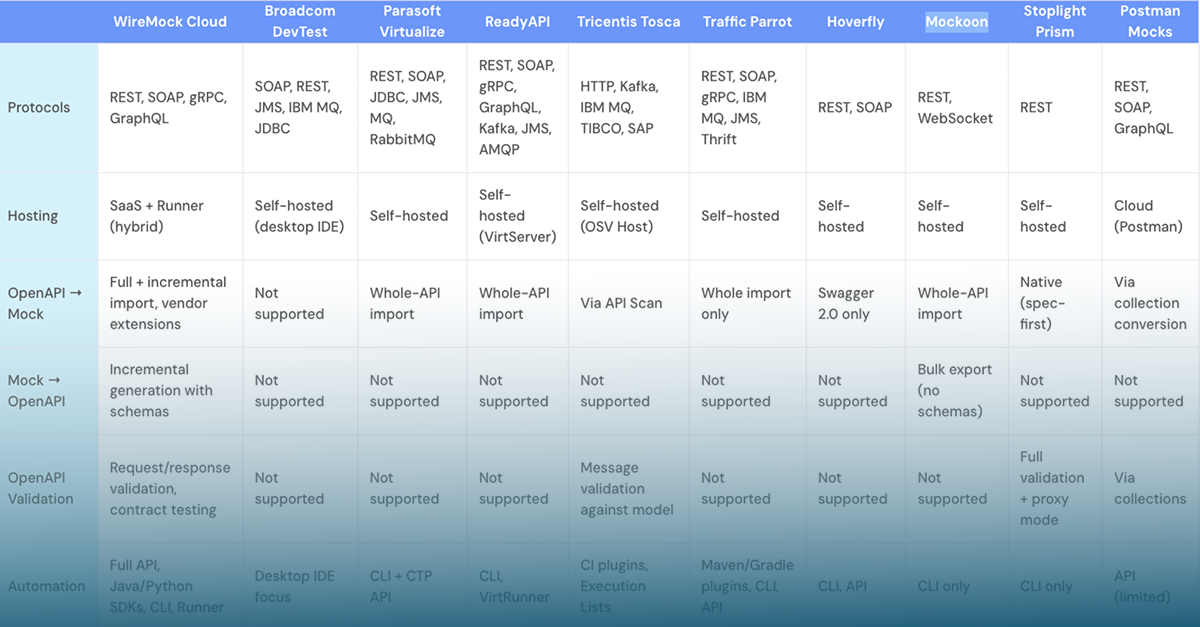
Feature Comparison at a Glance
Want to get down to the brass tacks? Here’s what each tool can do, as of February 2026:
| WireMock Cloud | Broadcom DevTest | Parasoft Virtualize | ReadyAPI | Tricentis Tosca | Traffic Parrot | Hoverfly | Mockoon | Stoplight Prism | Postman Mocks | |
|---|---|---|---|---|---|---|---|---|---|---|
| Protocols | REST, SOAP, gRPC, GraphQL | SOAP, REST, JMS, IBM MQ, JDBC | REST, SOAP, JDBC, JMS, MQ, RabbitMQ | REST, SOAP, gRPC, GraphQL, Kafka, JMS, AMQP | HTTP, Kafka, IBM MQ, TIBCO, SAP | REST, SOAP, gRPC, IBM MQ, JMS, Thrift | REST, SOAP | REST, WebSocket | REST | REST, SOAP, GraphQL |
| Hosting | SaaS + Runner (hybrid) | Self-hosted (desktop IDE) | Self-hosted | Self-hosted (VirtServer) | Self-hosted (OSV Host) | Self-hosted | Self-hosted | Self-hosted | Self-hosted | Cloud (Postman) |
| OpenAPI → Mock | Full + incremental import, vendor extensions | Not supported | Whole-API import | Whole-API import | Via API Scan | Whole import only | Swagger 2.0 only | Whole-API import | Native (spec-first) | Via collection conversion |
| Mock → OpenAPI | Incremental generation with schemas | Not supported | Not supported | Not supported | Not supported | Not supported | Not supported | Bulk export (no schemas) | Not supported | Not supported |
| OpenAPI Validation | Request/response validation, contract testing | Not supported | Not supported | Not supported | Message validation against model | Not supported | Not supported | Not supported | Full validation + proxy mode | Via collections |
| Automation | Full API, Java/Python SDKs, CLI, Runner | Desktop IDE focus | CLI + CTP API | CLI, VirtRunner | CI plugins, Execution Lists | Maven/Gradle plugins, CLI, API | CLI, API | CLI only | CLI only | API (limited) |
| Dynamic Responses | Handlebars templating, conditionals, Faker, JWT | Magic Strings/Dates scripting | JVM scripting | Groovy scripting | TBox rules, buffers | WireMock templating | Handlebars templating | Handlebars, Faker | Faker-based only | Basic variables |
| Stateful Mocking | Scenarios + dynamic key/value state | Supported | Via external data repos | Global variables via scripts | Core capability (orchestrated) | Scenarios (WireMock OSS) | Scenarios + dynamic state | Global state variables | Not supported | Not supported |
| Reliability Testing | Faults, delays, chaos mode | Limited | Performance profiles, delays | Delays, throttling, random errors | Delays only | WireMock fault support | Fixed/log-normal delays | Fixed delays | Not supported | Basic delays only |
| AI Integration | MCP server for AI coding tools | No | Natural language assistant | HaloAI (limited) | Tosca Copilot (UI) | No | No | No | Via SmartBear HaloAI | Postbot chatbot |
| Security | HTTP Basic, header auth, OIDC, RBAC/ACLs | Enterprise security | Not built-in | HTTP Basic, OAuth, digest, NTLM | Platform LDAP/SSO, TLS | Basic auth, 2 fixed roles | API token only | Not built-in | Not built-in | Not supported |
Where the Market Is Heading
The service virtualization market is at an inflection point. The dominant tools were built for a different era: quarterly releases, monolithic applications, centralized testing teams. Today’s reality is continuous deployment, thousands of microservices, and developers who expect self-service tooling.
This mismatch explains why so many teams struggle with their current service virtualization setup. Architecture decisions made a decade ago create daily friction with modern CI/CD pipelines, cloud infrastructure, and AI-assisted development.
There is no universal “best” tool. But the criteria that matter most now, including automation support, self-service workflows, and AI readiness, point in a clear direction. Tools designed around these principles will become easier to justify; tools that ignore them will become harder to defend.
If these criteria match your priorities, WireMock Cloud offers a free tier to test these ideas against your actual workflows, no sales call required; or you can get a guided tour here.
Frequently asked questions
What is the best service virtualization tool?
It depends on your architecture and workflow. For cloud-native teams that want self-service simulation and AI-assisted workflows, WireMock Cloud is the strongest fit. For organizations emulating deep legacy protocol stacks with a centralized team, Broadcom DevTest and Parasoft Virtualize remain the incumbents — at incumbent prices.
What happened to CA LISA?
It still exists — as Broadcom DevTest. ITKO’s LISA became CA Service Virtualization after CA acquired ITKO in 2011, then moved to Broadcom with the CA acquisition in 2018. Development has slowed in recent years, which is why many LISA-era teams are evaluating modern replacements.
Are there free or open-source service virtualization tools?
Yes. WireMock (open source), Hoverfly, and Mockoon are free to use, and Stoplight Prism is open source for spec-based mocking. They’re excellent for individual developers and CI pipelines; the tradeoff is that hosting, collaboration, and governance become your responsibility as usage scales.
What’s the difference between API mocking and service virtualization?
Mocking usually means lightweight, localized simulation of a specific API; service virtualization means simulating full environments and their behavior at team or organization scale. We break this down in API mocking vs. service virtualization.
How much do service virtualization tools cost?
Legacy enterprise platforms are sold on annual enterprise contracts, usually with separate support and implementation fees on top. Modern usage-based platforms price very differently — WireMock Cloud typically costs 50–80% less than legacy service virtualization.