Most teams already have a delivery workflow that works. Code lives in Git. Changes happen on branches. Pull requests are reviewed. CI runs tests. Releases move through environments in a controlled way.
Simulated APIs often sit outside that flow, which can reduce trust in mocked responses and complicate releases.
WireMock Runner (managed via WireMock Cloud) brings simulations back into the same Git and CI/CD path teams already use for everything else, so mock changes stay visible, reviewable, and tied to the work that depends on them.
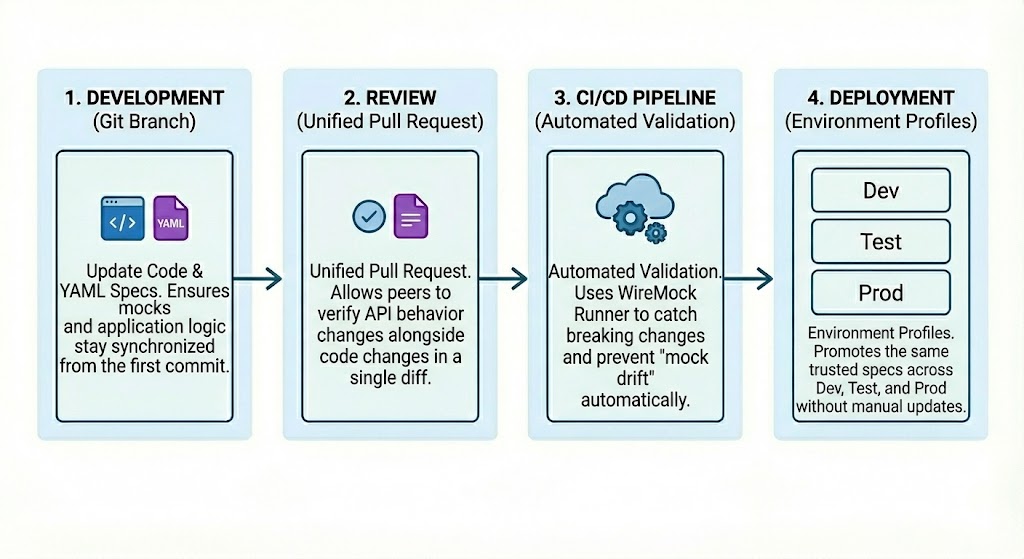
Put API simulation in the same workflow as your code
When mocks live only in a UI or a separate system, they tend to become “somebody else’s problem.” Updates are easy to miss, changes are hard to trace, and there’s a risk of drift as your system evolves.
To solve this, you want to bring API simulation under the same Git-first umbrella as the rest of your testing and development. If the work progresses through Git workflows, mock updates and lifecycle should happen there too.
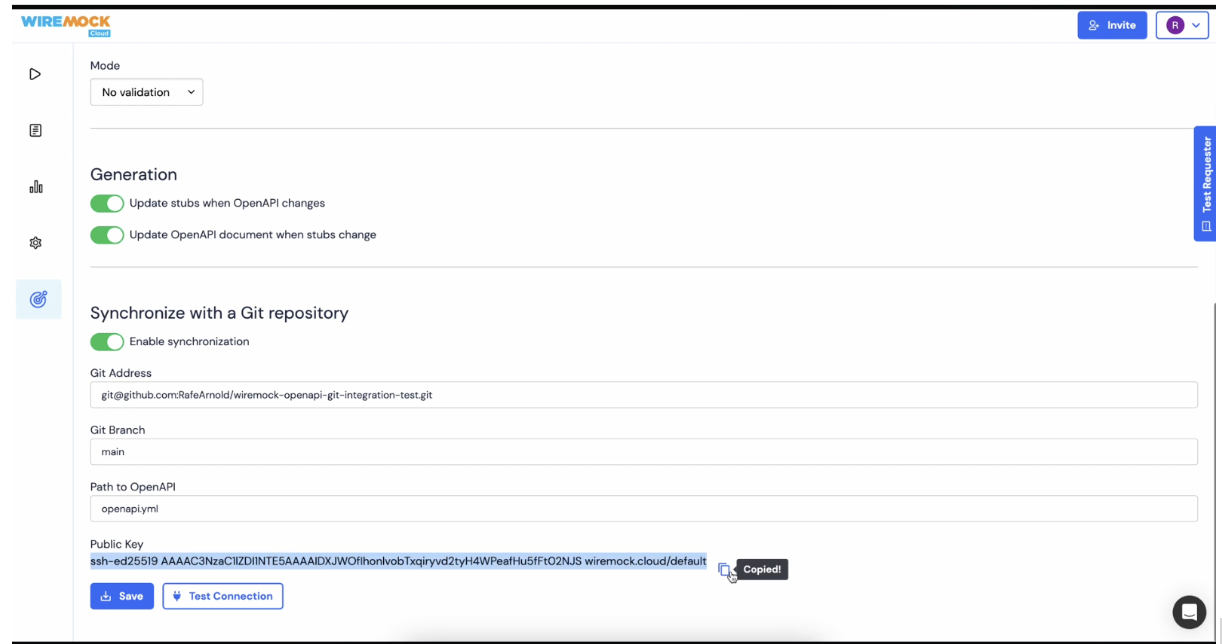
Learn more about Git integration with WireMock Cloud
Version mock APIs like any other artifact
With WireMock Runner, mock specifications live directly in your repository as YAML. They sit alongside the code they support and move through the same pull request process - so that
when a dependent service changes, the mock spec can be updated in the same branch as the application change. That keeps the mock and the code aligned, because they ship together.
Nothing about the workflow is new:
- Diffs look familiar because the specs are plain YAML
- The same reviewers can approve changes
- CI can validate the updates before they merge
The main change is that mocks stop being an external exception. They become part of the repo and part of the process - which makes them easier to govern, evolve and work with.
Make ownership and rollback straightforward
When mocks live outside Git, ownership is often unclear. It is hard to answer basic questions:
- Who changed this mock last
- Why did it change
- Was it reviewed
- What version did we run last week
Putting specs in Git makes the answers to these questions obvious. Every change has a commit, an author, and a review trail. If a change breaks downstream tests, you can pinpoint when it happened and revert it with the same workflow you use for application regressions.
For leaders, this is the practical benefit: traceability without adding a separate governance system.
Automate mock updates in CI/CD
WireMock Runner can run in CI or as a long-running service. In a pipeline, it can:
- Record API interactions to update mock specifications
- Run mocks in isolation for automated tests
- Pull the latest specs so every environment runs the same definitions
- Push updated specs back to Git when recordings change so updates stay reviewable
This removes the manual export and sync steps that usually cause drift. Mock updates are handled by the same automation that builds and deploys your applications.
Share mocks across teams without shared dashboards
Mock management gets harder as soon as multiple teams are involved.
One team owns a service. Another depends on it. A third runs integration tests. If mock updates happen manually in a separate tool, coordination breaks down quickly.
Git-based mocks give teams a shared coordination point:
- Service teams update mock specs when the API changes
- Dependent teams pick up those changes through normal Git workflows
- CI pulls the same specifications and runs consistent tests
Teams do not need to share dashboards or rely on somebody remembering to update a UI.
Use environment profiles without duplicating specs
Mocks often need slightly different specs across development, test, and production-like environments as new versions of the APIs being mocked emerge prior to production release. WireMock Runner supports simple environment profiles so you can keep variations in the same repository and promote them through Git like code.
Today, profiles stay intentionally focused. They map API definitions written in YAML to specific cloud-hosted mock APIs. That solves a routing problem without introducing new behavior or logic.
It also creates a clean place to expand later if you eventually need richer environment-specific behavior, but the default remains straightforward.
Use the guardrails you already have
Mock tooling can create parallel workflows. Leaders tend to resist that for good reasons. It increases risk and splits accountability across systems.
A Git and CI approach avoids that. Your existing guardrails apply:
- Pull request reviews
- Approval rules
- CI checks
- Audit trail and rollback
You are not adding a new policy layer. You are applying the same one you already trust.
Common workflows WireMock Runner + CI/CD enables
A few practical workflows get much easier when mock specs live in Git.
Promote mock updates with application changes
Update a service contract and the dependent code in the same branch. Update the mock spec alongside it. Review everything in one pull request. Promote everything through the pipeline together.
Refresh mocks from real traffic in CI
Record interactions against a real service during CI. If recordings update the spec, push those changes back to Git so they can be reviewed like any other generated artifact.
Keep environments aligned
Reuse the same mock specifications across environments, while profiles route traffic to the correct mock endpoints. Avoid copying files or maintaining separate repositories per environment.
Make mocks part of the development lifecycle
WireMock Runner makes mock management part of normal delivery. Specs are versioned, reviewed, and promoted alongside application code.
Instead of being maintained separately, mocks evolve in step with the systems they represent. That reduces drift, improves traceability, and makes it easier to use mocks across teams and environments.