AI lets teams write and ship patches faster than ever. Testing hasn’t kept pace, and last week showed what a single bad change can do.
On Thursday, November 12, a Microsoft 365 outage took Outlook, Teams and Copilot offline for more than a day across more than 70 countries. The next day, an FAA communications failure halted departures nationwide for several hours. Neither incident has been blamed on AI-written code. But both started with a routine change that rippled through systems nobody could fully test, and that is the same risk AI-assisted patching multiplies.
This post covers what we actually know, why AI-speed patching widens the gap between changing a system and understanding it, and how API simulation with WireMock Cloud helps close that gap before a patch reaches production.
What we actually know
The big outages had ordinary causes, but AI is changing how much change hits production, and how reliable that change is.
- Microsoft 365, Nov 12: Microsoft traced it to a network capacity upgrade and a later network change that caused front-end servers to fail health checks. Reconnecting clients then overloaded the remaining servers. Microsoft ruled out an attack and AI involvement (SC Media). Claims online that AI-written code caused it have no evidence behind them (Capital and Compute).
- FAA ground stop, Nov 13: the preliminary cause is data flooding the network during contractor work on a router at a remote site. The investigation is ongoing (SC Media).
- AI is now writing a large share of changes: GitHub reported that over 40% of pull requests began with an agent’s first draft by September 2026, up from 17% in March (cited by SC Media).
- AI-generated patches often aren’t right the first time: in a 1Password Off-By-1 study of 6,080 AI-generated patches for six vulnerabilities, only 26% fixed the flaw without breaking something else (The CyberWire).
- AI-assisted changes have already caused outages: Amazon tightened review rules for AI-assisted code after a series of disruptive incidents earlier this year (Ground News).
The real risk: patches move faster than testing
The danger isn’t that AI writes bad code. It’s that teams now ship more changes, faster, than they can verify against the systems those changes touch.
A patch rarely breaks on its own. It breaks when it meets a dependency: a payment provider that answers slowly, an identity service that returns an unexpected error, a partner API that changed its contract last month. Those are exactly the cases that are hardest to test before release:
- Shared test environments are contended. A dozen teams queue for one staging stack, so urgent patches skip the full run.
- Third-party sandboxes don’t behave like production. They’re rate-limited, out of date, or simply down, and they rarely let you trigger a timeout or a 503 on demand.
- Failure paths go untested. Most tests prove the happy path. Outages like last week’s are about what happens when something downstream is slow, failing or overloaded.
- Contracts drift quietly. A patch is tested against how an API behaved months ago, not how it behaves today.
When AI cuts patch-writing from days to minutes, every one of these gaps gets hit more often. Verification has to scale with generation.
How WireMock Cloud closes the gap
WireMock Cloud gives every team, and every AI agent, realistic simulations of the APIs a patch depends on, so each change can be tested against production-like behaviour, including failures, before it ships.
| Risk | What WireMock Cloud does |
|---|---|
| No environment to test the patch in | Spin up simulations of the services a change touches, in minutes, from an OpenAPI spec or recorded traffic. Every team and pipeline gets its own, so nobody waits for staging. |
| Third-party sandboxes don’t behave like production | Simulate partner and SaaS APIs with real-world behaviour, using stateful scenarios and data sources instead of fixed canned responses. |
| Failure paths go untested | Inject latency, timeouts, error codes and dropped connections on demand, so you can see what the patch does when a dependency is slow or down. |
| Contracts drift quietly | Contract validation and drift detection flag when a simulation no longer matches the real API, so tests stay honest. |
| Patches skip testing under pressure | Run simulations in CI/CD, so every patch, human or AI-written, goes through the same dependency and failure tests before it merges. |
| AI agents write code faster than people can test it | The WireMock MCP server lets coding agents create and use simulations from the IDE, so the agent that writes a patch can also test it against realistic dependencies. |
For teams with strict data or network rules, WireMock Runner and hybrid deployment keep simulation traffic inside your own environment.
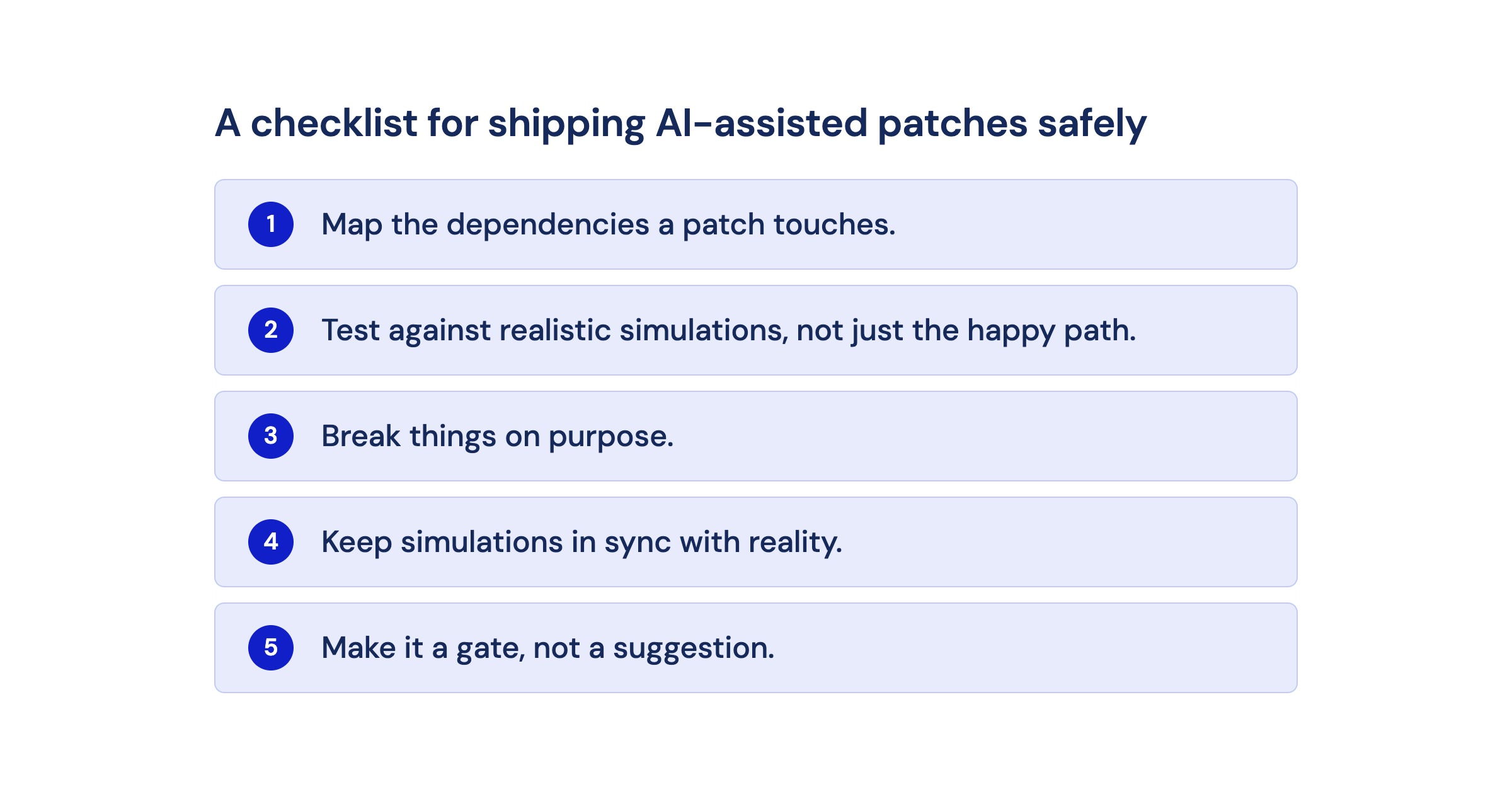
A checklist for shipping AI-assisted patches safely
Five habits that let you keep AI’s speed without inheriting its risk:
- Map the dependencies a patch touches. Know which internal services and third-party APIs sit downstream before you merge.
- Test against realistic simulations, not just the happy path. Every dependency on that map should have a simulation that behaves like production.
- Break things on purpose. Run each patch against slow responses, timeouts and error codes, so a struggling dependency can’t turn into a cascade.
- Keep simulations in sync with reality. Validate them against the real API’s contract so you aren’t testing against last quarter’s behaviour.
- Make it a gate, not a suggestion. Put dependency and failure tests in CI, and apply them to every change, whoever or whatever wrote it.
Speed and safety don’t have to trade off
AI-assisted patching isn’t going away, and with attackers using AI too, the pressure to patch faster will only grow. The teams that avoid becoming next week’s headline will be the ones whose testing keeps up with their output.
API simulation is how you get there: every patch tested against realistic dependencies, including the failures, before it ships. If you want to see what that looks like for your stack, book a WireMock Cloud demo.
Sources
- The Microsoft and FAA incidents show how AI accelerates change in systems we can’t afford to break, SC Media
- Did AI-Generated Code Cause the Microsoft 365 Outage?, Capital and Compute
- Researchers find that only a quarter of AI-generated patches are fully successful, The CyberWire
- AI-Generated Code Linked to Outages, Ground News